Tuesday, October 28, 2014

Frankenstein meets high society -- Like Capra on Acid

[pulling up some favorite moments with Frankie to wrap up the month]

Like Namor, Frankie started out as a superpowered enemy of mankind whose hatred was, if not justified, then at least understandable. Briefer often implied that some people could be just as monstrous as the title character.

There are echoes of Lady for a Day here (if the film had been set in hell*). Even for a product of the depression, this portrayal of high society is remarkably dark.


* Coincidentally, Pocketful of Miracles is often shown in hell.

Monday, October 27, 2014

Frankenstein meets Job (no, really)

[pulling up some favorite moments with Frankie to wrap up the month]

You never knew what you'd get in a Golden Age story, and I don't necessarily mean that in a good way. The freedom of working in a medium where the rules were still being written was too much for many creators and the resulting stories were often unreadable.

But when you got someone with enough artistic talent and narrative imagination to take advantage of that freedom, someone like an Eisner or a Cole or a Briefer, the results could be exhilarating.

From Prize Comics 31, 1943.


Sunday, October 26, 2014

Introducing Frankie

[pulling up some favorite moments with Frankie to wrap up the month]

Briefer was still growing as an artist and a writer when he created comics' first ongoing horror series and the medium was still in its infancy, but nonetheless there are signs of major talent in this 1940 story. Powerful images. A fine eye for composition and panel-layout. A flood of visual and narrative ideas.

Enjoy.


Saturday, October 25, 2014

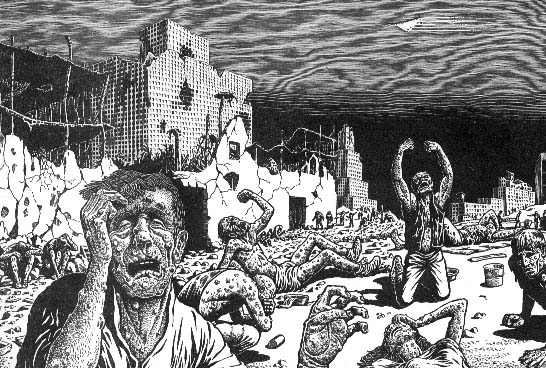
Forgive me for stretching the definition of 'horror' but if you're a Wolverton fan you should see these

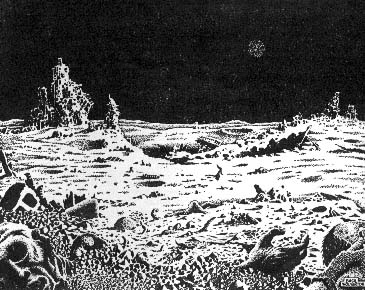
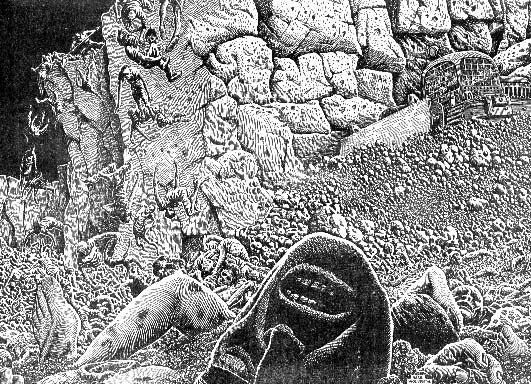
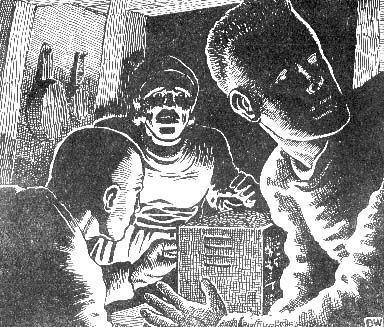
1975 as seen from these 1956 illustrations of Herbert Armstrong's pamphlet, "1975 in Prophecy." You can find more of these here and Monte Wolverton's discussion of his father's religious works here (at the bottom of the page).


Friday, October 24, 2014

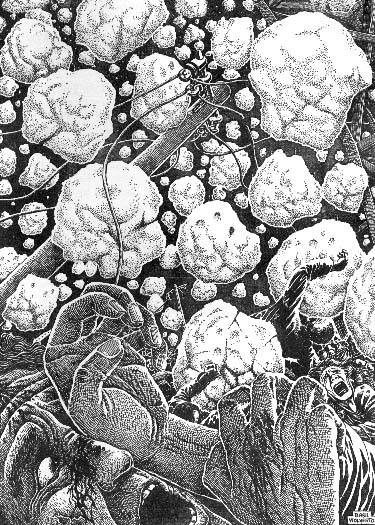
It's Wolverton -- "Weird" is redundant

[first posted in 2010]

Before DC's Plop! Before the head shop posters or Mad Magazine or even his winning entry in Al Capp's Lena the Hyena contest (judged by Boris Karloff, Salvador Dali and Frank Sinatra), Basil Wolverton was producing some of the most beautifully strange and strangely beautiful comics ever seen.

Wolverton's sense of narrative logic was always... well, let's just call it unusual. Sometimes, though, the lapses created the perfect dreamlike quality to match the images.


Wednesday, October 22, 2014

Wouldn't a swamp monster dry out in New Mexico?

[More Halloween reposts]


As mentioned before, the Heap was the first of the comic book swamp monsters. As Don Markstein puts it:
The Heap was comics' very first shambling muck monster, tho he was undoubtedly inspired by Theodore Sturgeon's 1940 short story, "It", the template for all shambling muck monsters to come. "It" told of a man who died in a swamp, fermented in a broth of rotting vegetation, and eventually rose again, half man, half fetid vegetable matter, to wreak vengeance upon his foes. Another prominent "It"-inspired comic book character of the 1940s was DC's Solomon Grundy, who bedeviled Green Lantern starting in 1944.

In The Heap's case, the man in the muck was Baron von Emmelmann, who had everything to live for — wealth, social position, loving wife, baby he hadn't yet seen, etc. — when, on October 12, 1918, his plane was shot down over Poland's Wausau Swamp. Lying lifeless as his body slowly merged with the morass, he had nothing left but his will to live, to rise, to return to the world of humans.
I have no idea how our shambling hero made it to the American Southwest, but if questions like that bother you then you shouldn't be reading comic book in the first place.